Showing posts with label BT Young Scientist. Show all posts

Sunday, March 08, 2015

Happy International Women's Day! : Guest Blog by Aisling Judge

So if anyone has been watching my twitter page, I've been travelling quite a lot recently to events like #WeDayUK. Because of this, I haven't had much time to update my blog, but I wanted to do something for International Women's Day. So I asked my sister Aisling, a graduated biochemical engineer who is now studying for a Masters in University College London, to write down a few of her thoughts on the subject. Here is what she had to say:


When I announced to my parents as a 17 year old that I thought I wanted to be an engineer they were surprised. Not because they doubted my capability but more due to the fact that I had never expressed an interest in the field before. In fact, I was vehemently set against the idea. You see, I come from a family of engineers. My father is a chemical engineer and for as long as I can remember all my brother (who is 4 years my elder) wanted to be when he grew up was an engineer. So yes, my resistance was partially driven by the fact I didn’t want to be seen to be taking the easy path by simply following in the family tradition but there was more to it than just that.

As a child I was not restricted by gender stereotypes in anyway. I was the ultimate tomboy, a trait my family fully embraced. I was more likely to be found playing with an action man than a barbie (although to be honest dolls of any kind weren’t really my thing!), while trips to Santa’s grotto would somehow involve the very loud specifications that I was a 6 year old ‘who loves playing with boy’s toys’ to tip off the unsuspecting elves that the blue parcel might be more appropriate. I envisioned myself becoming many things in my future but never thought of myself as an engineer.

For me it was nothing directly to do with gender per se, I never once thought I couldn’t be an engineer because I was female. Being in the minority has never been something which phased me and I will certainly never let it influence my decisions. The barrier to picturing myself in a hard hat or working on a computer design was not the perceived masculinity of the role or the academic challenges it may pose but more the skill set I thought it entailed, a skill set I believed I was lacking. You see, my brother grew up building things. Lego, Kinex, Lincoln logs - you name it, he had it. He loved everything about designing and creating and could spend hours and hours on end working on his masterpieces. It was often said by those who knew him that he was born to be an engineer.

As a young girl I quickly realised I was nothing like my brother. I never expressed such interests or aptitudes and so never thought engineering would be for me. Not because I wasn’t encouraged or exposed to such activities but quite frankly because I never found them stimulating. If something broke, I wasn’t rushing to try and fix it and I certainly never popped the car bonnet to have a look at the engine. Yet, even though I did none of these things when I was a child as I have progressed through my studies I have realised that I too was born with an engineering mind and maybe as a youngster I simply did not display my aptitude so clearly.

I believe that engineering in its essence centres on ‘logical problem solving’, which does not always manifest itself in hands on activities that are often associated with the career, but rather in more subtle ways. Of course when a child spends their time dismantling things and re-building them it almost waves a red flag for the parents that engineering might be a suitable future career option, but sometimes these skills can be more subtle and particularly in the case of girls, harder to spot.

As a youngster I almost never remember building or fixing something. Instead I loved puzzles, riddles and just about anything that made me think. Even better if the game didn’t have a single right answer, but rather required you to reason and justify your solution. As an 8 year old I could beat anyone young or old in the traffic jam logic game “Rush Hour”, in my early teens I was a whizz at Sodoku and most recently the Rubik’s cube has caught my attention. However on top of these interests I still played sport, read books and generally had many other hobbies which often overshadowed those problem solving skills. As a result I was never characterised as a budding engineer like my brother. A scientist, lawyer and even a journalist were mentioned, but not an engineer.

This I believe is where gender plays a role in the number of girls choosing to study engineering at third level. Not for the traditionally spouted reason of engineering being seen as a male-dominated career, but rather due to the gender disparity in the identification of the skill sets of our young people. There is no single subject on a school report card that will straight away alert a parent or student to an aptitude for engineering (while a talent for maths is important, engineering requires much more than just numeracy skills). If a student gets an A in accounting the business, economics and accounting opportunities will straight away be highlighted, good grades in chemistry and biology might encourage students into medical sciences, a prowess for english could lead to journalism and so such links can continue for many university degree’s.


Engineering is not so simple. It is often not what is done in the classroom that is the best indication of engineering talent, it is the way a student thinks and approaches problems that is key. The ability to identify these skills in a student seems to correlate with gender far too often, with girls more than capable of becoming fantastic engineers slipping through the net almost unnoticed because they demonstrate these strengths in a more understated way than their male counterparts. Yet if someone might have said to them “you think like an engineer” everything could have been different. Because after all, no one said that to me – and I very nearly missed my calling.


Aisling won the BT Young Scientist and Technology Exhibition in 2006 with her project entitled 'The development and evaluation of a biological food spoilage indicator.' She later placed 3rd in the EU Contest for Young Scientists with this project while representing Ireland in the competition. In 2014 she graduated from University College Dublin with a first class honours bachelors degree in Chemical and Bioprocess Engineering. She is currently studying for a masters in Biochemical Engineering in University College London. Aisling has long championed the involvement of Women in STEM, having written a guest column for Ireland's leading Tech and Innovation site, Silicon Republic on her thoughts on the matter.

Monday, January 12, 2015

The BT Young Scientist 2015

This was my 13th year attending the BT Young Scientist and Technology Exhibition, but I have to say, it certainly wasn't unlucky. The thing about this rather special event is that it hits you like a wonderful brick in the face right after New Years, and you are treated to a fantastic few days before it suddenly ends and you are left to think of ways to make the rest of the year pass quickly, just so it can be time for the BT Young Scientist again.


I like to think that every year of the BTYSTE is unique in its underlying ethos and theme, and for that reason I come away with a different impression from each exhibition. This year I was certainly struck by a sense of diversity and curiosity from the stands. Even within categories, topics and methods differed hugely, and it  seemed like students were investigating subjects in which they had a genuine interest (rather than just bunging in a project for the week off from school). I'm not a judge, so I obviously can't comment on the standard, but I know that I felt more enlightened walking away from most projects than I ever have in previous years.

People came in their droves to visit the BT Young Scientist 2015

I was lucky that at the BTYSTE I had the opportunity to do a little bit of everything. For one part, I was in charge of coordinating the activities of the Digital Youth Council. The BT Young Scientist gave us the opportunity to get our name out there to the student body: we conducted student interviews about digital learning and of course asked about their projects; and performed a pilot of a learning beyond the classroom 'School Skype' where RDS Primary Science Fair participants videochatted with their friends back in school to tell them about the exhibition. Although organising the events was a little stressful (you may have seen me looking a little haggard on Wednesday when we had several camera malfunctions) they were a huge success, and the Digital Youth Council will build on our activities at the BT Young Scientist at future events.

St. Peter's Bray Students with BT CEO Colm O Neill and Mick the BT redcoat!

During the times when I wasn't rushing around chasing a camera, I also acted as a mentor for the projects of Kinsale Community School (which basically just involved giving them water- we're an independent bunch). I love the sense of team spirit amongst the Kinsale projects this year, and watching my friends coming out of judging sessions with smiles on their faces brought me so much happiness. Something not often mentioned about the BT Young Scientist is the effect it has on people's personalities, particularly those in younger year groups. I now have friends in first and second year who I wouldn't have known at all if not for the BTYSTE acting as the gel that holds us all together. Students who I met at their first meeting in September and were too shy to speak to me were bursting with stories for me every evening after the exhibition, whether about their judging, new friends, VIP guests, or just something unusual happening near their stand!


Selfie no hate

I know that being a student of Kinsale Community School people might expect me to speak about the awards ceremony, where we did get a few prizes. But for me, and indeed all of Kinsale's entries this year, it is 100% not about the trophies. Of course it brought joy to my heart to see people who had worked, and who had put blood, sweat and tears into their projects get recognised, but that's not what the BT Young Scientist is about. Out of more than 2000 entries, 550 projects qualify for the RDS, and when you walk in the doors of the exhibition, that is you claiming your prize: the experience of a lifetime.

But of course, there are winners, and this year it was Eimear Murphy and Ian O Sullivan from Colaiste na Treasa in Kanturk. They were the well deserved BT Young Scientists of the year for 2015 for their study 'Alcohol consumption: Does the apple fall far from the tree?' Their being the second Social and Behavioral project to win in the 51 years of the exhibition, I honestly did feel like I was witnessing history seeing them up on stage. Their study was incredibly well carried out and interesting, but more importantly, from the short time I have spent with them, Ian and Eimear seem like great craic. I look forward to getting to know them over the next year, and they are a fantastic addition to the BTYSTE Family!


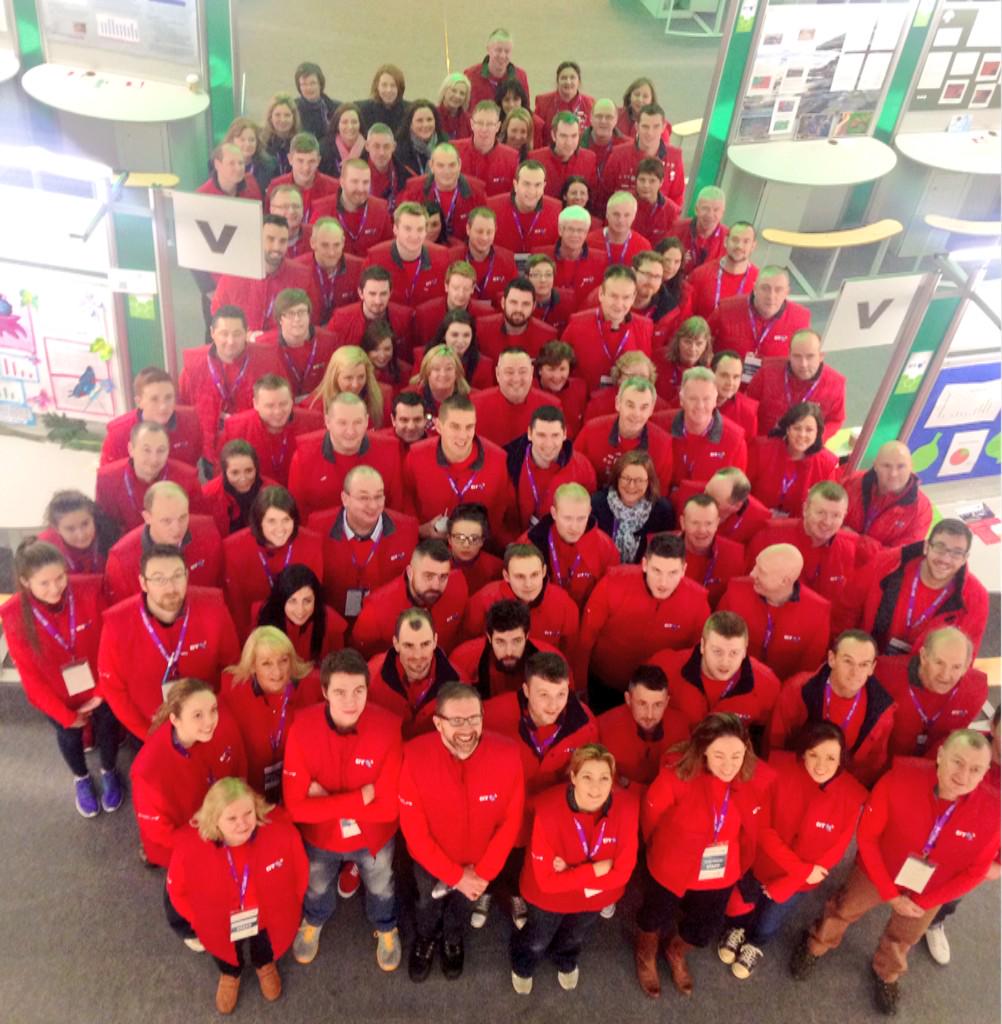
There's too many people to thank for an amazing week at the #BTYSTE , so I'm just going to pick a very important group of people who I like to think of as the unsung heroes of the BT Young Scientist and Technology Exhibition: The BT Redcoats. They work tirelessly all week to make sure students, sponsors and guests have an amazing time, completely voluntarily, and they're great banter too! I briefly had the honour of wearing a coveted red coat for a few minutes on Saturday evening, but the responsibility was too overwhelming for me: I'll leave it to the experts!


There's something quite special about the BT Young Scientist that nobody can quite put their finger on. You walk into the exhibition hall and you are hit with a sudden wave of heat, noise, and energy, which are all combined into a buzzing atmosphere. There isn't a frown in sight amongst the students, visitors or staff, and topics of conversation range from hair to the complexity of protein molecules. It is this fusion of youth, fun and science that students experience at the RDS, and it is for this reason that the graduates of the BT Young Scientist and Technology Exhibition are well equipped, confident, and competent students who blaze a path for Ireland all over Europe and indeed, the world!